


How F1 teams are exploring 2026's bargeboard reforms
Let's forget the divisiveness of the powertrain rules for a moment; F1's 2026 chassis rules have been largely well received so far. The reintroduction of bargeboards, once a dirty-air problem child, have helped generate closer racing - here's how the teams have tackled them

Autosport Explains
Our experts decode the most important stories in motorsport.
It's probably an understatement to say that Formula 1's 2026 regulations have been divisive. Debate and derision over the 2026 powertrains have dominated the discourse of late, and one hopes that a resolution can be found to iron out some of the more unsightly problems introduced by the 53-47 split (at full power, at least) between the internal combustion engine and the electric motor.
Overall, it's a shame that the negatives associated with the powertrains have soaked up all of the attention, because F1 does have the core of something good here. The chassis regulations have, largely, been considered a success; the FIA set out to produce a more agile machine (the word 'nimble' has become increasingly ubiquitous) that the drivers could use as a better demonstration of their skills behind the wheel. The drivers seem to be enjoying that particular aspect of the car; to the minds of most, if we could keep the chassis regulations and stick something else in the back, F1 might be in a good place. But that's a few years away...
The idea of the ground effect regulations sounded promising on paper, and the theory was that the reduced reliance on over-body aerodynamics would minimise the impact of turbulence (or 'dirty air') on the chasing cars. F1 cars are designed to run in clean, laminar airflow; while you can theoretically simulate an F1 car in the wake of another, turbulence models in computational fluid dynamics will never be exact and nor can they account for every single permutation available.
The front end loses downforce in dirty air, which makes the following car suffer with front-end sliding, and the tyre overheating causes the chasing driver to back off. It's a problem as old as time. But the regulation change didn't really fix this, and nor did it reduce the reliance on the drag reduction system.
In fact, DRS was arguably less powerful, which made DRS trains much more common - especially by the end of the ruleset. Add to that the stiff suspension needed to keep the ground-effect underbodies working consistently, and it's no surprise that the drivers didn't really enjoy having their vertebrae ground into dust by the bouncing present in the former cars.
Several attempts had been made to minimise the airflow 'outwash', considered the biggest cardinal sin of modern F1 cars, out of the equation. Simplifying the complexities of the front wings in 2019 helped to some degree, as did reducing the bargeboard size, but chasing cars were still met with a barrage of turbulence while attempting to shape for an overtake. For 2026, the stance was to reintegrate 'inwash' into the equation, something which teams have actively avoided since wider front wings were introduced back in 2009.

The smaller, lighter cars in 2026 have been largely well received
Photo by: Alastair Staley / LAT Images via Getty Images
Pre-2009, it had been more common to incline the trailing edge of the endplates inwards, allowing the front wing flow to be pulled between the wheels and the chassis. Some teams tried to persist with this when the front wings were widened, but others very quickly cottoned onto the idea of turning the airflow outwards around the front wheel to minimise tyre wake. Hence, outwash became very much in vogue.
The return to inwash seems to have helped keep the wake turbulence in a smaller box. Although many of 2026's overtakes have been helped by differing states of battery charge, the more benign aero package has made this possible overall. Reforming one of the worst offenders in producing outwash into a force for good has been key to this, culminating in the reintroduction of the bargeboard - but now, in an entirely new role.
A look across the grid very much demonstrates that the 11 teams have taken quite different approaches to the bargeboard package, depending on how their aero platform works. The ultimate idea of the reformed bargeboard is to take the tyre wake, clean it up, and direct it between the gearbox and the rear wheels. This packages the tyre wake within the overall wake profile of the car, rather than sending more turbulence around the sides of the car.
There are three main schools of thought with the bargeboard package, which can contain up to three distinct elements
"To promote that closer racing what they are trying to do is keep the dirty air from the tyre as inboard and as high as possible," explains Williams' chief aerodynamicist Juan Molina. "So when it comes to the back of the car, it doesn't go to the sides and it doesn't affect the car behind. In that case they've tried to limit quite a lot how we outwash the wheel wake, which is something that we try to do to keep the flow clean to the floor.
"That's something that is quite a challenge and as you see the front wings are simpler, but also something that's quite visible in the bargeboard is in-washing, so that's forcing all the dirty air to go back to the floor.
"A lot of work goes into how we can manage all those structures to keep the flow clean; the wheel wake is our biggest enemy. So trying to manage that to keep the flow driven to the floor and then expanding the diffuser, that still remains quite important.
"What's the most optimum to regain that load? Well, we will see during the season what the right concept is, but I think the general idea still remains to regain as much load as possible on those items."
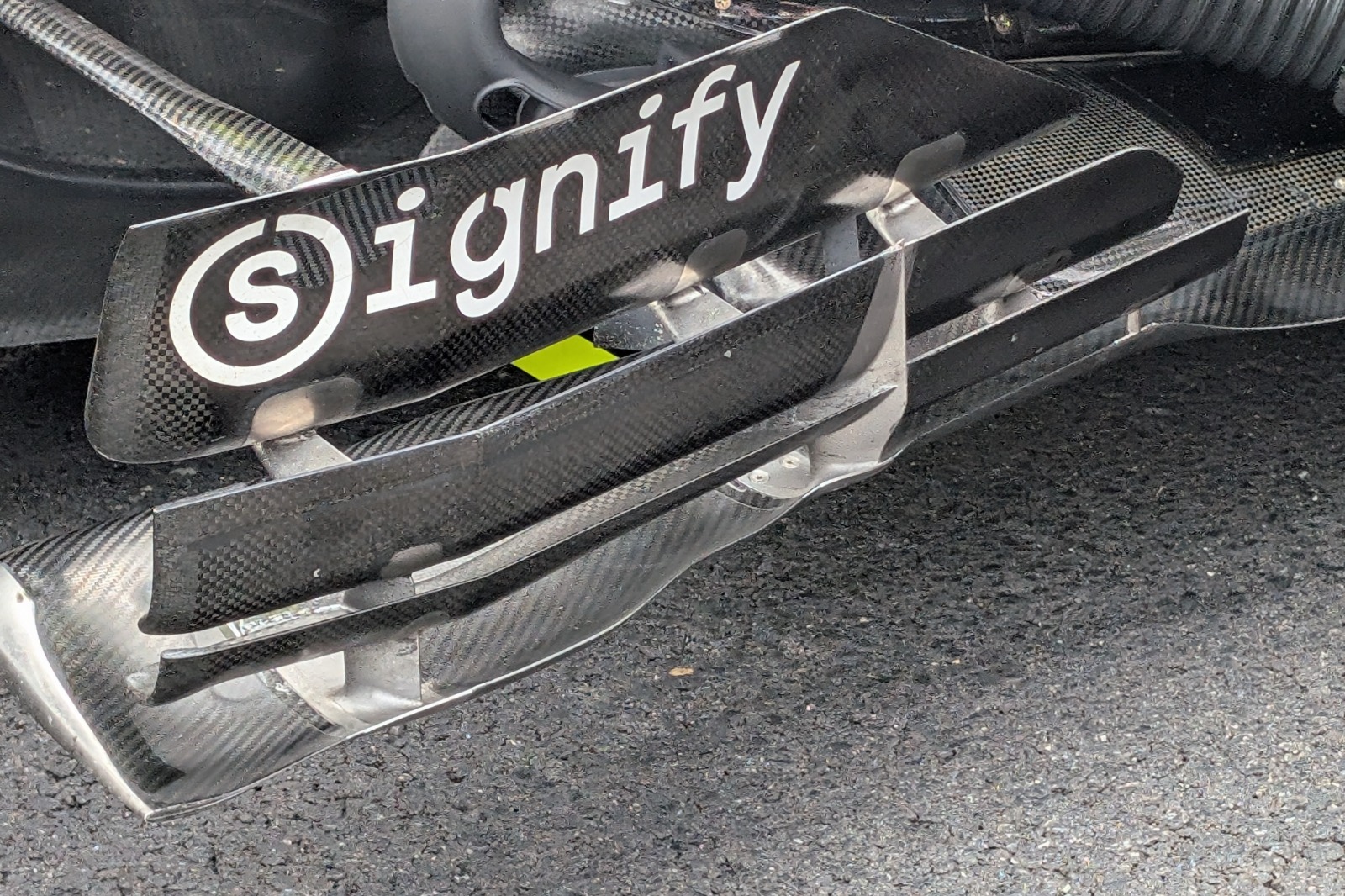
Mercedes' three-slat bargeboard
Photo by: Jake Boxall-Legge
As it stands, there are three main schools of thought with the bargeboard package, which can contain up to three distinct elements. We have a triple-slatted design with equal chord lengths, the three slats with an attached leading-edge vertical element, and a larger-chord top element with two smaller slats situated underneath. Interestingly, the top three teams all operate with a different variant of the above.
And if you've seen the word "slat" and "element" too much in the above paragraph, we'll show you what we mean.
In our example of the three-slat design, we have the likes of Mercedes and Red Bull. The bargeboards are mounted onto an extruded floor section, where the teams have used a curled outer edge to interact with the three bargeboard pieces. As Molina says, the inclination of the three pieces demonstrates how the teams are using the wakeboard to lift the airflow upwards and even generate a little bit of load from the curvature of the wing. This is especially true of the lower two elements, while the upper piece handles the bulk of the flow-conditioning towards the rear of the car. Audi also uses a similar layout here.
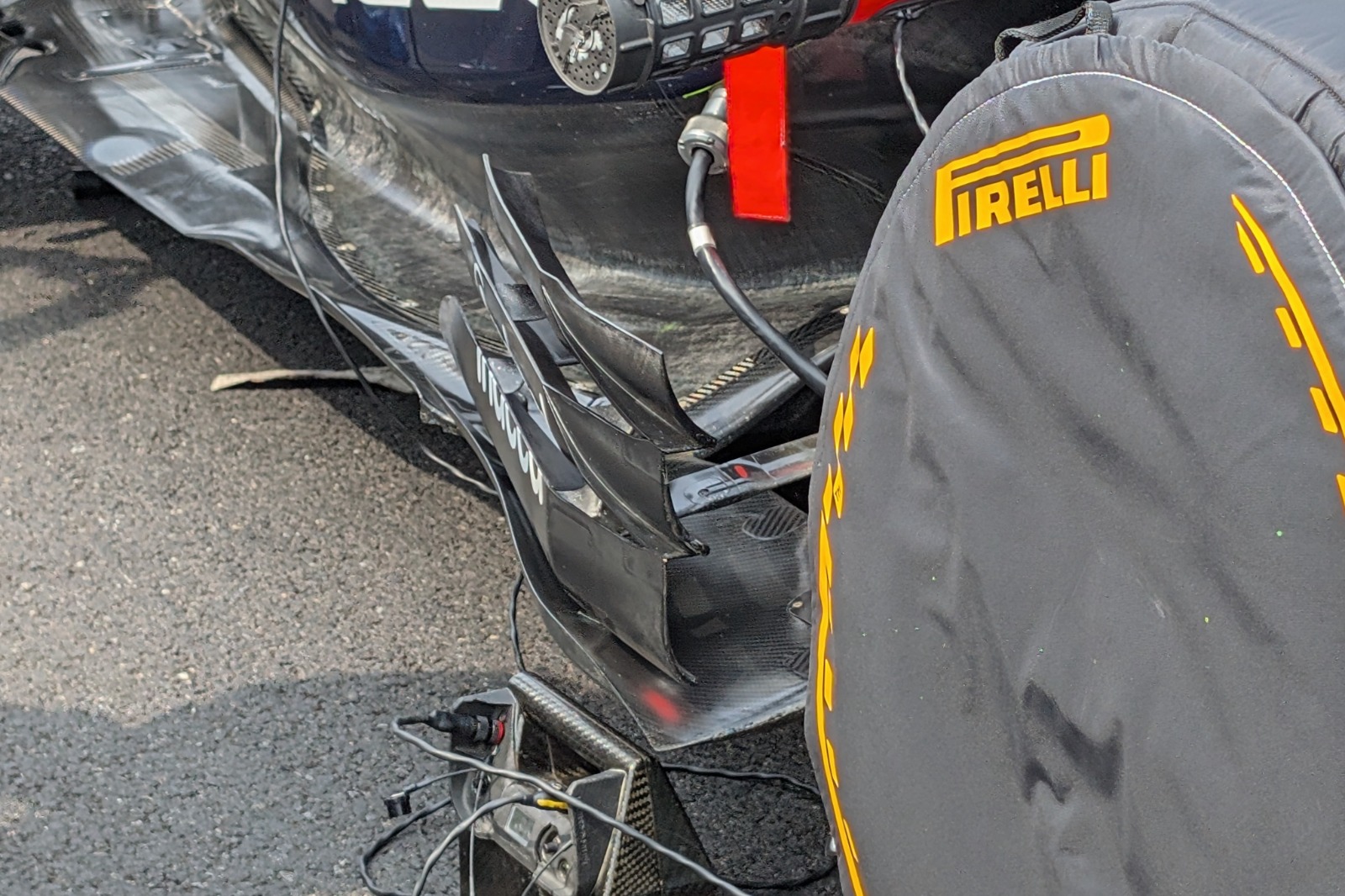
Red Bull's 2026 bargeboards - note how they incline towards the sidepod
Photo by: Jake Boxall-Legge
The image of the Red Bull bargeboards above also demonstrates the tools that the teams are using on the inside face of the bargeboard to control the flow. For example, the brackets used to mount the elements together are used also to enhance the flick-up effect on the airflow, with additional inner fins to strengthen the airflow sent around the sidepods. Although the bargeboards have a specific purpose, the teams naturally want to milk them for every single additional shred of performance available.
Ferrari, Haas, and Racing Bulls have a marginally different approach, in that they use the three-slat design but with the additional of a vertical leading edge element.
This is used to condition the flow before the rest of the bargeboard does its work to untangle the tyre wake turbulence, with a slight twist at the top to induce a tiny degree of outwash. Alpine uses a hybrid of the two designs detailed, where its upper slat is extended at its top edge with a longer vertical strut.
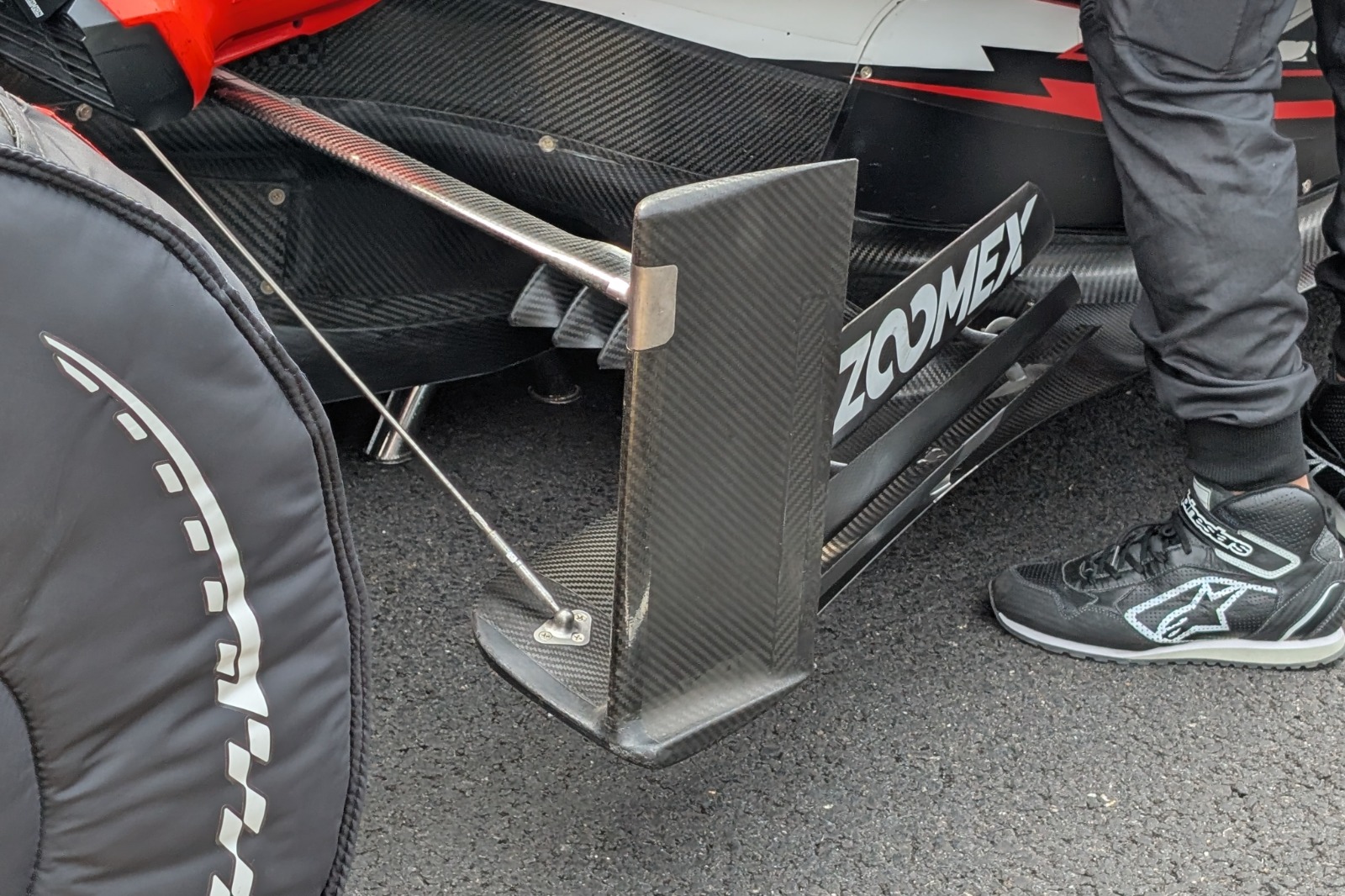
Haas' bargeboard cluster features a larger vertical element at the front
Photo by: Jake Boxall-Legge
We then have the larger top panel, used by McLaren, Aston Martin, Williams, and Cadillac. The top element features some curvature along its bottom edge to help generate the upwash, but the shorter-chord elements that this sits on allow for a more aggressive change in the airflow path without creating as much induced drag. McLaren and Williams both have a vertical split to break up the larger upper piece to further mitigate this.
The shape of the bounding boxes ensure that the teams must all create the inward-facing trailing edges of the bargeboard. Although many of them will find ways to recoup some degree of outwash for the tyre wake as the current regulations mature, it seems that the aerodynamicists' endeavour is sufficiently penned in.
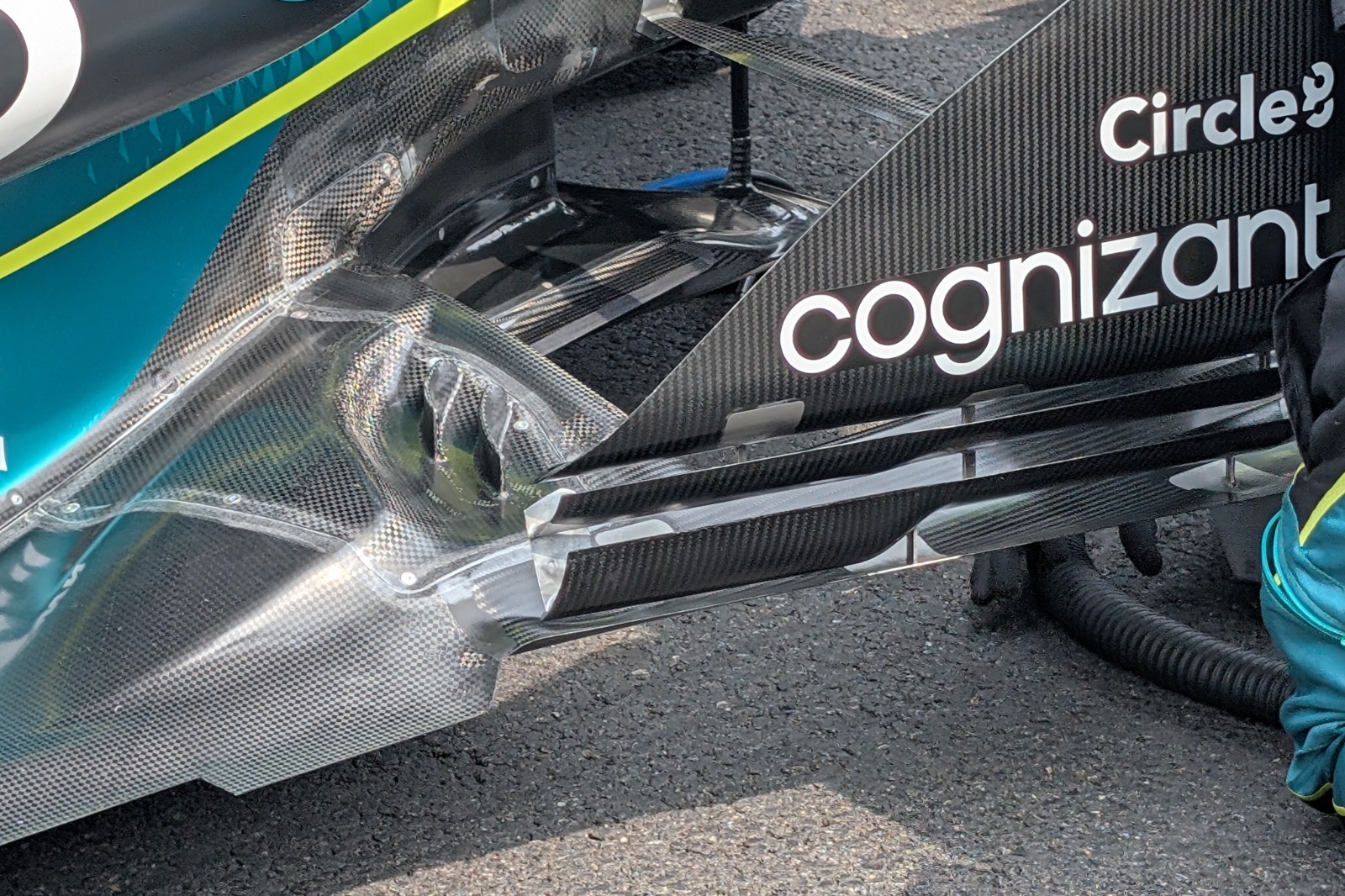
Aston Martin introduced this bargeboard package in Australia, featuring two shorter-chord elements underneath a larger top panel
Photo by: Jake Boxall-Legge
Although some are also trying to use the front wing furniture to enhance this, the narrower geometries take away many of the tools that aerodynamicists once used to pull the wake away from the front wheels. Even with the restrictions of the last ruleset, teams began to use the endplate-to-element attachment points to include little winglets that enhanced the outwash effect. So far, especially with the active aero slant, few have ventured into that level of complexity.
While it's still early days, and the difference in power units has largely diluted the effect of the aero development so far, it's still possible to see the differences from car to car - particularly among those using common powertrains. So far, the shift to a more conventional aerodynamics package (active aero notwithstanding) has been largely appreciated, along with the lighter and smaller form of the '26 cars.
For the current powertrain sceptics, it's something to hang onto...

2026's cars have been able to stay closer for longer - at least compared to the end of the previous ruleset
Photo by: Clive Mason / Getty Images


How Ferrari must step up its efforts to end its long F1 championship wait

The biggest surprises and disappointments of F1's 2026 field so far

The pros and cons of F1's enforced break and cancelled races

Analysis: Antonelli is leading F1's title hunt, but is he quicker than Russell?

Stella was right about F1's closing speed problem - but here's why there's no simple fix

Verstappen's journalist spat exposes a greater issue in undervaluing media

Japanese Grand Prix Driver Ratings 2026

How Bearman's 50G crash saved Antonelli's bacon in Japan

What happened to Evans and Solberg at WRC Rally Croatia

WRC Croatia: Pajari holds off Neuville to lead after Friday drama

The key figures Red Bull has lost over the past three years

Trackhouse team owner on why MotoGP must take risks to grow in the US
Subscribe and access Autosport.com with your ad-blocker.
From Formula 1 to MotoGP we report straight from the paddock because we love our sport, just like you. In order to keep delivering our expert journalism, our website uses advertising. Still, we want to give you the opportunity to enjoy an ad-free and tracker-free website and to continue using your adblocker.


Top Comments