


What options are on the table for F1’s 2026 rules?
The review of F1 2026 continues with a technical meeting on Thursday that is not expected to produce immediate decisions. It is part of a wider evaluation process ahead of the Miami Grand Prix, with several potential improvements on the agenda

The unwanted spring break that Formula 1 has been forced into due to the war in the Middle East may have two unexpected positives. First, it prevents F1 from racing through the fast streets of Jeddah, where the closing speeds that played a role in Oliver Bearman’s crash would, according to drivers, have been even more dangerous.
Secondly, it gives the FIA and F1 time to take a thorough look at the regulations. The governing body emphasises that it’s part of an ongoing process, just like the meeting with all teams after the Chinese Grand Prix. The consensus at the time was that there was no need for a ‘knee-jerk reaction’ and that it would be better to use the break between Suzuka and Miami for a more detailed evaluation.
That evaluation will continue on Thursday 9 April, although it is important to note that the meeting is not expected to lead to immediate decisions. It will initially be a discussion between technical representatives, during which several areas for improvement and possible solutions will be explored.
It will be followed by another technical meeting, before a discussion with team principals later in the break - 20 April - where more concrete decisions can be made, subject to approval from the World Motor Sport Council.
The main agenda
Until Sunday afternoon in Suzuka, the consensus among both the teams and the FIA was that the focus should primarily be on ways to improve qualifying, and that the races - at least in terms of their entertainment value for fans - had not been too bad.
But, following Bearman’s crash, safety has moved to the very top of the agenda. The incident involving Franco Colapinto and the Haas driver has reignited the discussion about closing speeds, with many drivers - including Carlos Sainz - emphasising that they had been warning about such an accident for some time.
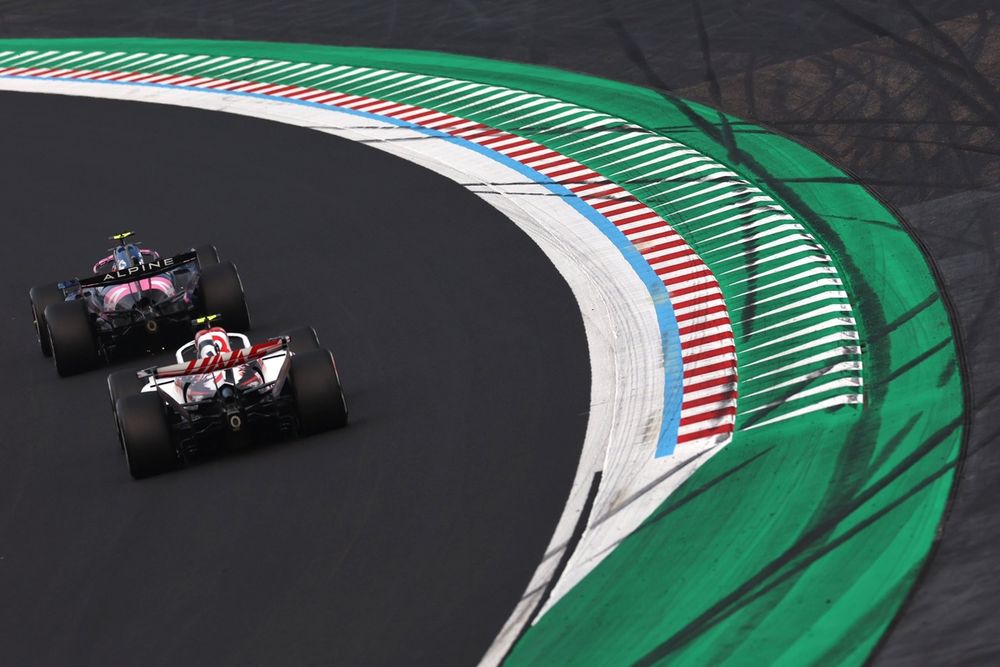
Bearman suffered a 50G crash at Suzuka after trying to avoid the battery harvesting Alpine of Colapinto
Photo by: Alastair Staley / LAT Images via Getty Images
Qualifying, however, remains a second key topic and is the subject where there appears to be the most agreement in advance - at least regarding the basic principle that it should be more about pushing the limits than what has been seen during the first three race weekends.
Even the teams that are currently most competitive seem open to changes in order to achieve that goal. “If it were up to me - and we definitely need to look at this - how can we get that one fast, brutal qualifying lap again?,” Mercedes team boss Toto Wolff said. “And how can we reduce the lift and coast? That’s definitely something we need to do.”

Charles Leclerc shares that view. After his initial complaints, the Ferrari driver now finds the racing entertaining, but still believes qualifying needs to be addressed - particularly as he has been punished several times and actually became slower the more risk he tried to take in Q3.
Finally, there are several aspects that rank slightly lower on the priority list but still require attention. The first is that drivers do not always feel fully in control of the energy management. Lando Norris said after the Japanese Grand Prix that he did not even intend to overtake Lewis Hamilton at the chicane, but was simply “at the mercy of what the power unit deployed”.
This is partly related to overtake mode, but also to safety mechanisms that make the MGU-K deliver 200kW for a short period when a driver goes back on the throttle after lifting. However, this drains the battery even further, leaving a driver completely powerless on the next straight.
Leclerc encountered another problem during sprint qualifying in China, where at one point he applied 97% throttle instead of 100%, which effectively confused the power unit. The energy management was disrupted by his tiny lift, causing Leclerc to suddenly lose half a second on a straight later in the lap.

Leclerc previously built up a reputation as F1's best qualifier, but has found it tricky in 2026
Photo by: Ferrari
“I was very, very, very frustrated, because the lift was, I think, two percent or three percent of throttle, which is kind of nothing. It’s in the vibration of the foot,” he reacted.
The possible solutions: can slower cars make things better?
As for the potential solutions, Max Verstappen doesn’t want to get his hopes up and expects any improvements to remain marginal. The four-time world champion, who has been the most outspoken about the new rules, reiterated in Japan that he is hoping for bigger changes ahead of 2027, something that plays an important role in his “life decisions” about the future.
Nevertheless, there are several parameters the FIA can play with, as single-seater director Nikolas Tombazis described it. For the remainder of 2026 there are roughly three main themes that could be addressed - besides the quirks that Norris and Leclerc encountered in China and Japan.
The first aspect is a suggestion already raised by McLaren team principal Andrea Stella in Bahrain: increasing super clipping to the full 350kW. Stella was the first to warn about the enormous closing speeds, envisioning a scenario where one driver has to lift while another deploys energy. That represents the most extreme example and, according to him, could be mitigated by increasing super clipping to 350kW.
The amount of energy drivers are currently allowed to harvest while at full throttle is limited to 250kW, while with lift and coast drivers can recover the full 350kW. By raising the super clipping limit to the same value, Stella and many others in the paddock argue that the speed profile should at least become more natural.
More super clipping may still not be what all fans want to see - especially on onboard footage - but it is at least considered safer and less extreme than full lift and coast.

Super clipping is when a driver harvests energy while still at full throttle
Photo by: Alastair Staley / LAT Images via Getty Images
Besides super clipping, the FIA could also look at both the harvesting and deployment sides of the rules. Regarding the latter, the governing body has several options. It could lower the maximum deployment from 350kW or adjust the so-called ramp-down rate, which would ideally make it take longer before drivers run out of MGU-K power.
On the harvesting side, the FIA already made a small change ahead of the Japanese Grand Prix. The amount of energy drivers were allowed to recover for a qualifying lap had initially been set at 9 megajoules, but was reduced to 8 megajoules before the start of the race weekend.
The FIA considered this necessary because simulations suggested more super clipping would be required than originally expected. According to the federation, the change reduced super clipping from 10 seconds per lap to six, while lap times increased by only half a second.

Although these figures vary from circuit to circuit, the FIA could theoretically go significantly further than the Suzuka example. In the paddock, even 6 megajoules has been suggested by some teams as a fairly radical - but potentially effective - intervention, or perhaps a compromise number in the middle.
By allowing drivers to recover less energy, they would need to rely less on lift and coast and super clipping. It would mean drivers could push more with what they have, but it would come at a certain cost: slower lap times.
According to initial estimates, reducing the limit to 6 megajoules could increase lap times by more than two seconds at some tracks, although the question remains how problematic that really is. Yes, it would make F1 slower, but if drivers can push more (albeit with less electrical power), it may visually look closer to fighting the limit than the current situation.

F1 2026 cars are slower than their ground-effect predecessors
Photo by: Andrew Caballero-Reynolds / AFP via Getty Images
Apart from the power unit side of things, active aerodynamics is theoretically another element to look at. Its introduction was necessary in the first place to drastically reduce drag and therefore allow the new power unit rules to function. At the moment its use is limited to the straight mode zones defined by the FIA, but in theory this could be opened up, at least in qualifying.
Besides further reducing drag, this would have another effect: it would make active aero more of a tactical element than it is now. Some teams could opt for more extreme solutions - low downforce for extra top speed on the straights, but requiring the wing to close at every change of direction - or a middle ground where a driver can use the active aero on more sections of the track.
The political reality: a safety issue or not?
The final question is how sensitive some of these aspects may be. For the change introduced in Japan, the FIA told teams that it would only implement such a measure if all teams unanimously agreed.
The FIA wants to keep all parties aligned as much as possible throughout the entire process, although in theory it could play the safety card after Bearman’s crash. In that case the FIA could introduce some changes unilaterally - which is exactly what Verstappen advocated post-race.
“Well, if it's all about safety, then it's easy to fix things. You can use safety for a lot of stuff. So maybe we should use the word safety for it, to finally make some changes,” the Red Bull driver said.
In practice, however, most parties involved agree that the overall product is not fundamentally broken and - at least on Sunday - still doesn't require a ‘knee-jerk reaction’. There appears to be sufficient willingness to introduce changes for qualifying, in order to make those laps more about finding the limit again. Aspects that go beyond that and also affect the competitive picture during races could prove more problematic - especially for those who currently hold a competitive advantage through effective energy management.

The FIA has to balance the interests of teams and the championship as a whole
Photo by: Mark Sutton / Motorsport Images
It is precisely the tension that Tombazis already highlighted in the build-up to 2026: the overall interest of the championship versus the interests of individual teams. According to Tombazis, everyone invariably claims to act in the interest of F1, but the reality is often more nuanced.
“Yes, of course, that is a challenge - because, as I've said various times, we as the FIA care about the health of the sport,” he said. “They also care about the health of the sport but also whether they win races or not, and that complicates things a bit.”
Alongside these possible short-term adjustments, the question is also emerging of what could be done in a more structural sense towards 2027 and the remaining years under this ruleset.
What is often referred to as the 50-50 split between the internal combustion engine and the electrical components is in practice roughly 53% versus 47%. There are voices in the paddock suggesting the combustion engine might need to become slightly more prominent for the upcoming seasons, although that - and potential ways of doing it - is a concern for later.
The first priority is to come up with an overall package from the Miami Grand Prix onwards that most stakeholders - and ideally the fans as well - can live with. Safety is the priority after Suzuka, and qualifying laps must once again be closer to the limit. The challenge for the FIA is finding a solution that ticks all those boxes without creating new problems elsewhere.


Lambiase’s move to McLaren makes sense - but Red Bull faces another big hole to fill

How Wolff’s joke about Verstappen in Zandvoort has become the new reality in F1

Why Norris’ comments perfectly capture F1’s 2026 dilemma

Could Verstappen really leave F1? The two factors that are different this time

“At the mercy of the power unit” – the moment that frustrated Norris and Verstappen

What's going wrong at Red Bull as it drops into F1 midfield?

Why Honda can’t solve the vibration issues alone and needs help from Aston Martin

Honda clarifies F1 timeline after Newey comments: “It is a misunderstanding”

What happened to Evans and Solberg at WRC Rally Croatia

WRC Croatia: Pajari holds off Neuville to lead after Friday drama

The key figures Red Bull has lost over the past three years

Trackhouse team owner on why MotoGP must take risks to grow in the US
Subscribe and access Autosport.com with your ad-blocker.
From Formula 1 to MotoGP we report straight from the paddock because we love our sport, just like you. In order to keep delivering our expert journalism, our website uses advertising. Still, we want to give you the opportunity to enjoy an ad-free and tracker-free website and to continue using your adblocker.


Top Comments