


Where Cadillac has taken risks with its first-ever F1 car
Cadillac might be new to F1, but its first-ever car does not look especially conservative. We've taken a look at where the incoming American squad has really pushed the boat out

Autosport Explains
Our experts decode the most important stories in motorsport.
Rain rather put a dampener on the second day of Formula 1's top-secret Barcelona shakedown test so it was of little surprise that those who'd made it to Catalonia had been wary of running on a damp track - although a few chose to brave the conditions to add some more mileage on their box-fresh cars and powertrains.
Some of the more established outfits didn't even have the luxury of choice. Williams didn't even make it to the shakedown, and Aston Martin will miss at least one day of running at the Circuit de Barcelona-Catalunya from the allocation of three. These are teams who have been on the grid for years; while they could theoretically spin that 'extra development time' into a genuine performance advantage, the optics of missing a defined boundary do present the press officers with more than a few quandaries.
(On a quick tangent: missing a test does indeed look bad, and a cursory look at the comments on another article suggested that we didn't castigate either team enough. What good would that do? Brawn missed the first collective test at Jerez on the eve of 2009. Red Bull missed the equivalent test at Valencia in 2010. It's not helpful for a team by any stretch, but let's not feed the hyperbole machine...)
That said, those black Cadillacs made it to the party; a brand new team got a car out for a private shakedown at Silverstone, and then went out on the first day at Barcelona to prove a point. For all of the hurdles that the team had to clear on the way to the grid, with F1 presenting itself as a closed shop until General Motors positioned it as a full-works entry, and continued opposition from the other teams, it was a statement.
Now, what we don't know is if the car - name yet to be determined - is any good. Like most teams, Cadillac was attempting to scoop out the hairs in the soup and debug the car before Bahrain - and while both Valtteri Bottas and Sergio Perez got laps on the board, it was not through much in the way of continuous running.
"To get laps in is the main objective," Perez mused after day one. "We're just getting some laps on the board, which was promising. We have, I'll say, a lot of issues today, which is good. It's our first day, so it's been positive in that regard. You know, you want all the problems to come now, and hopefully the next couple of days can be a lot smoother for us."
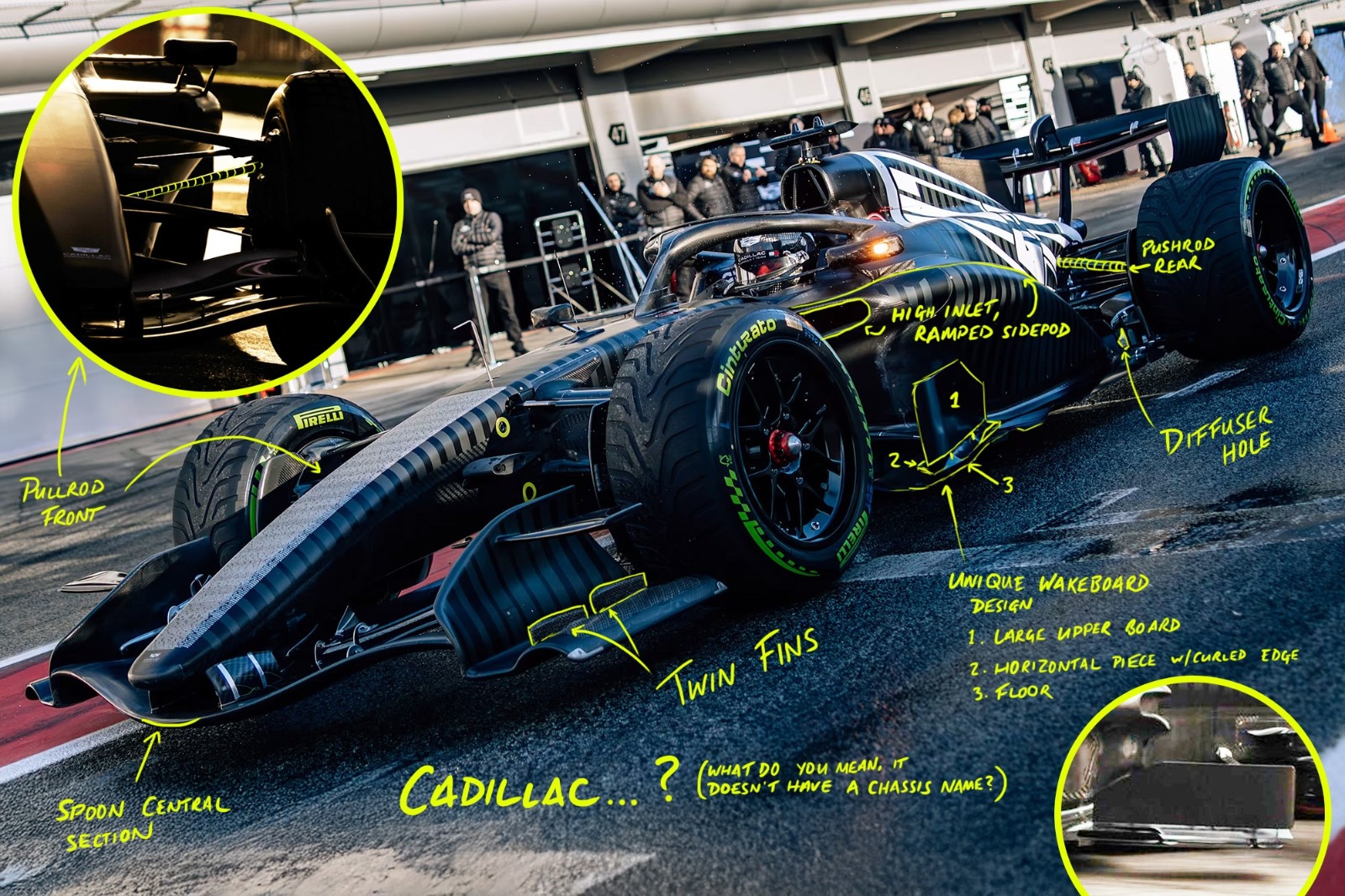
It's difficult for a new team to design a car: firstly, where do you even start, and which part do you design first? Luckily, Cadillac began with some defined dimensions in taking Ferrari's powertrain, plus the chassis bounding boxes, and they can begin to work from there. The temptation might be to take a conservative route, but Cadillac hasn't; it features some genuinely intriguing design decisions, with some divergent from the forming trends seen in the 2026 cars.
Take the front end, for example; while the form immediately puts one in mind of a Midland M16 (niche, sure, but it features a handful of common ancestors) with the drooped, squared-off nose and sweeping front wing, the twin-fin endplates and odd curvature around the vortex tunnel demonstrate the attention to detail.
The uniqueness continues around the front suspension package, for example; the positioning of the steering arms to align with the top wishbone is an interesting decision to make. One imagines that it services as a point of interaction for the wishbone's front leg, since there's no push-rod here to do this as the front suspension runs with pull-rod activated rockers. Only Alpine has elected to run with a similar geometry - at least, of the cars we've seen thus far.
The suspension layout, from an aero standpoint, should allow the inboard airflow to be fired down towards the bottom of the sidepods to keep the inlet flow relatively clean. These are high and letterbox-like, merging into ramped sidepods that partially tuck in at the trailing edge to allow the flow around the car's midriff to merge correctly.
While many of the teams have opted to chop their wakeboard/bargeboard devices into smaller elements, Cadillac has led with one much larger board, which sits on a second "flat" piece which curls up at the trailing edge, which itself is mounted just above the extended floor area. This is, so far, a unique approach; as long as the flow can stay attached as it is recycled from the pocket of shed tyre wake.
Cadillac is also one of the teams to have included a "hole" in the diffuser, which is a little bit of a misnomer; some teams are breaking up the diffuser edges to help provide a seal, and to link it to the winglets attached to the rear uprights - effectively expanding the workable diffuser area.
What else have we seen in the shakedown?
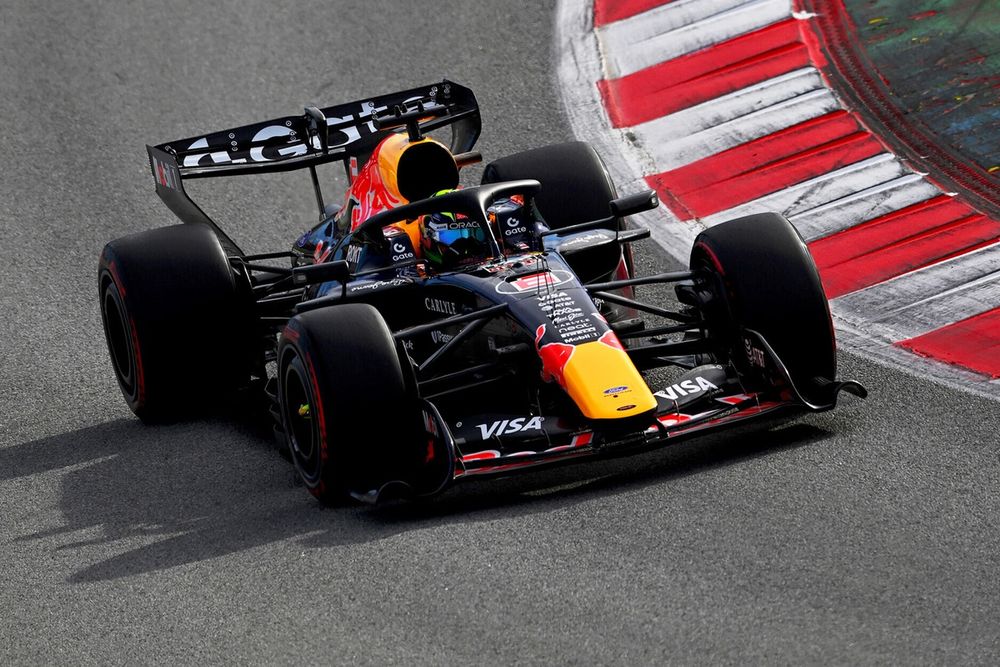
Photo by: Red Bull Content Pool
Red Bull's full RB22 has been seen for the first time, as its livery was rendered onto an earlier-spec model of the car. While there are similarities, the front wing has a much flatter mainplane, while the sidepods also have a slightly different opening - using the crash structure facade to guide the airflow down a ramped upper surface.
It's interesting to see the team's commitment to the inwash concept at the rear, as everything tucks in nicely and cleans up the space for airflow around the top surface of the diffuser - where a hole is indeed present along the side.

Photo by: Formula 1
Alpine's A526 is, as explained in Friday's feature, nothing like the launch model. The front wing is the polar opposite to the Red Bull with dramatically raised outboard sections, which house strakes to help modulate the airflow underneath. Rounder sidepods and a nose that appears to have been borrowed from a 2008 GP2 car also set off the clear visual differences to the launch model - as does the pull-rod front suspension.

Audi's proper R26 has also been revealed after launching its livery on the standard 2026 F1 concept model. Note the sculpted nose, designed to minimise lift and any pockets of dead air underneath, inwash sidepods, and three-piece wakeboard.

Photo by: Audi


How Ferrari must step up its efforts to end its long F1 championship wait

The biggest surprises and disappointments of F1's 2026 field so far

The pros and cons of F1's enforced break and cancelled races

How F1 teams are exploring 2026's bargeboard reforms

Analysis: Antonelli is leading F1's title hunt, but is he quicker than Russell?

Stella was right about F1's closing speed problem - but here's why there's no simple fix

Verstappen's journalist spat exposes a greater issue in undervaluing media

Japanese Grand Prix Driver Ratings 2026

What happened to Evans and Solberg at WRC Rally Croatia

WRC Croatia: Pajari holds off Neuville to lead after Friday drama

The key figures Red Bull has lost over the past three years

Trackhouse team owner on why MotoGP must take risks to grow in the US
Subscribe and access Autosport.com with your ad-blocker.
From Formula 1 to MotoGP we report straight from the paddock because we love our sport, just like you. In order to keep delivering our expert journalism, our website uses advertising. Still, we want to give you the opportunity to enjoy an ad-free and tracker-free website and to continue using your adblocker.


Top Comments