


Top 10 F1 team debuts
Cadillac and Audi are arriving in F1 for 2026, so we thought now was a good time to look back at the best performances by new teams in championship history

Autosport Retro
Telling the forgotten stories and unearthing the hidden gems from years gone by.
Making an immediate impact in Formula 1 can be extremely tough. As Cadillac and Audi – one a new entity, the other having taken over Sauber – prepare for their debuts, we rank the best performances by new teams in the history of the championship.
For this list we have focused on the very first grand prix for each team, rather than the whole season. We have excluded constructors that were well established when the world championship began in 1950, so no Alfa Romeo (1-2-3 on its ‘debut’) and Ferrari (second at Monaco).
One challenge has been weighing up pace versus reliability. The importance of being competitive on raw speed and that of scoring points on your debut has depended on circumstances but we’ve leaned slightly towards a demonstration of strong performance over finishing. Very occasionally, a newcomer demonstrates both…
10. Haas, 2016 Australian GP

Haas surprised all on its debut as Grosjean took sixth in a dramatic race
Photo by: Dirk Klynsmith / Motorsport Images
Result: 6th (Romain Grosjean), Retired (Esteban Gutierrez)
Given the high level of all teams on the F1 grid in the 21st century, coming in and making an immediate impact is incredibly hard. But Haas showed it was still possible with a fine start to its campaign in 2016. That’s why it gets the nod over Lotus, which also finished sixth on its debut in the 1958 Monaco GP.
While Esteban Gutierrez went out of the Australian GP in a dramatic crash with McLaren’s Fernando Alonso, the ensuing red flag enabled Haas to change Romain Grosjean’s tyres. Grosjean, who had climbed into the top 10 as others made pitstops just before the accident, then ran to the end on the medium-compound rubber to take sixth after starting 19th, one spot ahead of his team-mate.
“You aim high and you want points but after qualifying we didn’t expect to finish sixth,” admitted team principal Guenther Steiner. “This was beyond our expectations.”
It’s probably fair to say that Haas’s partnerships with Dallara and Ferrari – which provided engine, gearbox and suspension – provided some shortcuts and helped the team hit the ground running, but it was still a fine start.
Grosjean then qualified ninth and finished fifth next time out in Bahrain. Haas held fifth in the constructors’ table for the first part of the season before falling back to a still-respectable eighth out of 11.
9. Sauber, 1993 South African GP

A year out of racing gave Sauber plenty of time to prepare for its F1 debut
Photo by: Sutton Images
Result: 5th (JJ Lehto), Retired (Karl Wendlinger)
Sauber had proved its worth in Group C, winning Le Mans in 1989 and dominating the 1989 and 1990 world sportscar championships with Mercedes power. The Mercedes presence had grown stronger through the 1980s and there was a chance for that tie-up to continue into F1.
The plan was for Sauber to be part of a Mercedes F1 return, probably with sportscar star Michael Schumacher among the line-up, but Mercedes changed its mind. Peter Sauber’s squad pressed on, however, with some support from the Three-Pointed Star and Ilmor engines.
Even after designer Harvey Postlethwaite left, the project still had some good, experienced names, including Leo Ress, Mike Gascoyne and, briefly, ex-McLaren and Ferrari man Steve Nichols. Sauber didn’t race in 1992 so had a good amount of preparation and was a well-oiled machine thanks to its time in Group C, so it was perhaps better placed than most debutants when it arrived at Kyalami for the 1993 season opener.
JJ Lehto qualified an impressive sixth despite a spin, albeit three seconds off pole, with team-mate Karl Wendlinger 10th.
The two C12s benefited from some start chaos, including Damon Hill spinning his Williams, to complete lap one in fourth and fifth. That only lasted five laps before Lehto was forced in with a gearbox issue that required an ECU change. He resumed two laps down and began a charge that would include a fastest lap better than all but winner Alain Prost’s.
Wendlinger briefly moved to fourth before a stop/go penalty for jumping the start dropped him to eighth. He was running sixth when an electrical issue halted him just before half-distance, but Sauber’s day was not done.
Lehto’s pace and problems for others brought the Finn up to seventh and he attacked Derek Warwick’s Footwork for the final point as a rain shower hit in the closing minutes. Lehto overtook the Briton, who then spun off, and Gerhard Berger’s Ferrari failed on the final lap, leaving Sauber to take two points for fifth.
Just three rounds later Lehto went one place better at Imola and, though it fell back as others developed their cars, Sauber ended its first F1 season seventh in the constructors’ table.
8. Matra, 1968 South African GP

Stewart gave Matra its F1 debut using its development MS9 that was built in just 10 days
Photo by: David Phipps
Result: Retired (Jackie Stewart)
For this entry, we’re not counting the occasions on which Matra F2 cars started world championship GPs, we’re assessing the French company’s first proper F1 foray with Ken Tyrrell’s ‘Matra International’ team in 1968. And we could pick at least two races.
Matra’s development car, the MS9, was used at the opening round in Kyalami on New Year’s Day! It had a Ford Cosworth DFV, so was a full-capacity F1 car, albeit an ugly and undeveloped one. “The car was most impressive, considering it was built only 10 days previously,” reported Autosport.
Jackie Stewart outqualified everyone except the Lotus 49s of Jim Clark and Graham Hill, then managed to lead at the end of the opening lap. Clark swiftly returned to the front, but Stewart kept Hill at bay until lap 28 of 80. He still had the second Lotus in sight when the Matra’s DFV failed just after half distance.
The MS10, Matra’s first ‘proper’ F1 car, was ready by round two in Spain but Stewart was not, having been injured in an F2 accident. Jean-Pierre Beltoise lined up a respectable fifth on the grid and finished there after a race of attrition.
When Stewart did get his hands on the MS10 – at round four in Belgium – he came within a lap of winning before running out of fuel and being classified fourth. Stewart went on to finish second in the table and then dominated for a Matra title double in 1969 with the MS80.
7. Red Bull, 2005 Australian GP

Red Bull made an eye-catching start to life as an F1 team - even if it was as good as it would get in 2005
Photo by: Red Bull Racing
Result: 4th (David Coulthard), 7th (Christian Klien)
Like several entries on this list, Red Bull wasn’t an entirely new entity, Dietrich Mateschitz having got hold of the Jaguar operation that started life as Stewart. Several key elements – such as getting design genius Adrian Newey from McLaren – had yet to fall into place when David Coulthard and Christian Klien lined up on row three for the 2005 season opener.
The Cosworth-powered RB1’s qualifying performance had been impressive, albeit helped by rain, and Coulthard remained in the mix throughout the GP. A great start and then a lunge on Mark Webber’s Williams at the first corner got him up to third and he ran second once the lighter fuelled Toyota of Jarno Trulli pitted.
Coulthard had to get robust with Webber in traffic at one point but succeeded in beating the Williams-BMW despite being briefly overtaken. He didn’t have the pace to prevent being jumped during the second stops by the flying Ferrari of Rubens Barrichello or the recovering Renault of Fernando Alonso, which had qualified 13th, but fourth was still a fine result. Klien came home seventh, so Red Bull sat third in the constructors’ table after its first GP.
“It’s a great start, we couldn’t have dreamed of a better debut,” said team boss Christian Horner. “There’s a lot more to come.”
Red Bull wouldn’t match that seven-point haul again in 2005, but the team quickly established itself as a legitimate F1 contender.
6. March, 1970 South African GP

A podium with Stewart gave March a very strong start in F1
Photo by: Motorsport Images
Result: 3rd (Jackie Stewart), 10th (Jo Siffert), Retired (Johnny Servoz-Gavin, Mario Andretti, Chris Amon)
Putting five cars on the grid for your first world championship race is pretty remarkable. Almost as outstanding as one of your customers winning round two, even if that was Stewart driving for Ken Tyrrell.
At the Kyalami opener in 1970, Stewart put Robin Herd’s new, Dunlop-shod, March 701 on pole. Works driver Chris Amon sat alongside on Firestone tyres, while Jo Siffert lined up ninth, Mario Andretti 11th and Johnny Servoz-Gavin 17th in the second Tyrrell-entered car.
Stewart led from the off as Amon clashed with Jochen Rindt’s Lotus, the works March soon retiring with overheating. The reigning world champion initially pulled away but Jack Brabham, delayed at the start, quickly moved through from sixth to be second by the end of lap six.
Brabham started closing the 6.1s gap to Stewart and was with the overweight March after 18 of the 80 laps. Stewart was powerless to stop the BT33 taking the lead and then fell back towards Denny Hulme’s McLaren, which went by just before half-distance.

Stewart nevertheless completed the podium, with Siffert finishing 10th after a spin and pitstop for attention to his exhaust. Andretti had radiator problems and didn’t finish, while Servoz-Gavin’s engine failed.
Stewart would win the non-championship Brands Hatch Race of Champions in the March and Amon topped the BRDC International Trophy just a week after Stewart’s Spanish GP success. Thereafter March fell back as others got their acts together and there were no more wins, but third in the constructors’ championship was still a fine result with what was essentially a rather compromised, simple race car.

5. Lancia, 1954 Spanish GP

Lancia stunned on its F1 debut but wouldn't reap the rewards of its D50 due to financial difficulties
Photo by: Motorsport Images
Result: Retired (Alberto Ascari, Luigi Villoresi)
It was a long time coming but when Vittorio Jano’s D50 arrived it was sensationally fast. Reigning double world champion Alberto Ascari had been forced to sit out most of the 1954 GP season, aside for unsatisfactory outings with Maserati and Ferrari, but finally got to give Lancia its debut at the Spanish finale, alongside team-mate and veteran Luigi Villoresi.
Ascari put the V8 machine, with its pannier fuel tanks, on pole by over a second from the Mercedes W196 of Juan Manuel Fangio. After an early bid from the fast-starting and lightly fuelled Maserati of Harry Schell, Acari took the lead but only stayed there until the end of lap nine of 80 before his clutch failed. Villoresi had already gone out with brake issues but the D50’s speed had not been in question – nobody bettered Ascari’s early fastest lap for the rest of the three-hour contest.
“The new Lancias did not last long, but Ascari demonstrated the remarkable acceleration of the tiny GP machine,” reckoned Autosport.
The D50 would go on to be a grand prix and world championship winner – but not for Lancia. Financial woes meant the D50s were handed over to Ferrari during 1955.
4. Tyrrell, 1970 Canadian GP

The Tyrrell 001 was fast but unreliable
Photo by: David Phipps
Result: Retired (Jackie Stewart)
While Stewart had given the March 701 its first pole and victory, the car was not really a particularly good one. But Ken Tyrrell had a plan, running the March while designer Derek Gardner secretly worked on the first F1 car to carry Ken’s name: the 001.
It made its race debut at the 1970 Oulton Park International Gold Cup, where it proved fast but retired. It was a similar story when it arrived in the world championship, Tyrrell making its debut as a constructor at Mosport, round 11 of 13.
Tyrrell entered a March for Francois Cevert and he qualified fourth, but Stewart – having tried March and Tyrrell in practice – was the only DFV-engined runner to get on terms with the Ferrari 312B. With Lotus having lost lead driver (and soon-to-be posthumous world champion) Rindt at Monza, Stewart pipped Ferrari’s Jacky Ickx to pole by 0.1s in the troublesome 001.
The new Tyrrell then ran away from the field and was 14.2s clear after 14 laps. The Scot looked in control until lap 32 of 90, when 001 suffered a front stub axle failure in what was “generally considered the toughest GP of the year”, according to Autosport.
“Stewart made it very clear that the Ferrari is by no means invincible,” reported David Phipps after the Italian squad recorded a 1-2.
The final two rounds were the same: the Tyrrell proved fast, then failed to finish. But Stewart would take 001 to second place in the 1971 opener in South Africa before dominating the championship in 003 for a Tyrrell title double.

3. Wolf, 1977 Argentinian GP

Scheckter stunned for Wolf with victory as its competition faded due to a series of issues
Photo by: David Phipps
Result: 1st (Jody Scheckter)
As far as F1 shocks go, this is a big one. Jody Scheckter only qualified 11th for Wolf’s debut in the 1977 Argentinian GP, in the only WR1 present. But, in a race of attrition, Scheckter moved through the field to take victory in the Harvey Postlethwaite-designed car.
It wasn’t an entirely new team, of course, Walter Wolf having bought Frank Williams Racing Cars. Frank Williams initially stayed on but soon left and the WR1 was an all-new car for the renamed squad.
Scheckter qualified 11th, 2.08s behind poleman James Hunt’s McLaren, but jumped to eighth on the opening lap. He gained another spot when Tom Pryce had a moment trying to pass Carlos Reutemann’s Ferrari.
Scheckter lost seventh to Carlos Pace’s charging Brabham and then another to Patrick Depailler’s Tyrrell but got one place back when the six-wheeler started hitting myriad issues. That summed up the day: Niki Lauda’s Ferrari retired with a fuel metering problem; the McLaren of Jochen Mass lost third when the engine cut out and he spun; leader Hunt’s McLaren had a suspension breakage; Mario Andretti’s Lotus 78 failed him; and the gearbox and rear suspension on early leader John Watson’s Brabham started to come apart.
All this helped the consistent Scheckter move into second on lap 42 of 53. Only Pace’s Brabham now lay ahead, and the Brazilian was suffering from heat exhaustion in the blistering conditions. The Wolf dived past with just over five laps to go and Scheckter crossed the line 43.2s ahead of Pace, who then collapsed.
“If you had told me this morning I was going to win this race, I would have said you were mad,” said Scheckter.
Autosport added: “Thew new Wolf team came out on top simply by doing all the right things, which in itself says a lot for the strength of the team.”
While the victory was fortuitous, Wolf proved to be a competitive proposition throughout the season. Scheckter would score nine podiums, including three wins, from the 17 races and finished second in the standings.
2. Mercedes, 1954 French GP

Mercedes dominated almost instantly with the W196
Photo by: Motorsport Images
Result: 1st (Juan Manuel Fangio), 2nd (Karl Kling), Retired (Hans Herrmann)
Everyone had been here before. When Mercedes rocked up at the 1914 French GP with five cars, it had come away with a 1-2-3. It hadn’t won the 1934 French GP with its new W25 but the writing was on the wall and domination followed. Mercedes’ arrival at Reims for the 1954 French GP, less than a decade after the end of the Second World War, was met with a certain amount of anxiety and expectation.
And Mercedes delivered. The attention-grabbing, streamlined W196s lined up 1-2-7, Fangio outpacing reigning world champion Ascari’s Maserati by over a second around the high-speed Reims circuit.
Karl Kling led the early going before Fangio moved ahead. The duo exchanged the lead a number of times before crossing the line 1-2, a lap clear of the rest in a rain-hit race. Newcomer Hans Herrmann had climbed to third, to make it a Silver Arrows 1-2-3, before his straight-engine failed but still came away with the lap record.
As a sheer demonstration of technical superiority and brilliant preparation on your F1 arrival, no team has come close – before or since.
“With an entirely new conception of a Formula 1 machine the German technicians proved conclusively that their absence from GP racing has in no way impaired their skill,” said Autosport in the 9 July 1954 magazine. “At one fell swoop, Italian supremacy was shattered.”

1. Brawn, 2009 Australian GP

Brawn's 1-2 to start the 2009 season was a fairytale story
Photo by: Sutton Images
Result: 1st (Jenson Button), 2nd (Rubens Barrichello)
Perhaps the lesson here is: to make a brilliant F1 debut, try to make it so that it isn’t really your first time. Mercedes had plenty of grand prix heritage before its F1 debut in 1954 and the 2009 Brawn squad had essentially been Honda mere months before.
The Brawn squad gets ahead because, although far less dominant than Mercedes, it achieved its success off the back of Honda failure, whereas the Silver Arrows arrived having been the dominant force the previous time it had been in the game – and had already won Le Mans since its return to motorsport.
The story is well-told. After dismal seasons (eighth and ninth spots in the constructors’ table respectively) in 2007 and 2008, Honda announced its shock withdrawal from F1 amid the global financial downturn, apparently leaving the team high and dry. Team boss Ross Brawn and chief executive Nick Fry led a buyout and secured Mercedes engines, saving the day.
What that really meant was that the new Brawn GP team had funding from Honda, experienced staff, good engines – and a car for F1’s new regulations that had already had much time and money lavished upon it. The BGP 001 also had the controversial double-diffuser trick and clever front-wing endplates.
Nevertheless, the team’s debut was still stunning. The new rules turned the formbook on its head and Jenson Button and Rubens Barrichello qualified 1-2, the pole time 0.6s faster than third-placed Sebastian Vettel’s Red Bull.
There’s not a lot to say about Button’s race. He led every lap to pull off a fairytale victory. Barrichello suffered a terrible start, triggered first-corner chaos and completed the opening lap in seventh. But he pushed on and took second when Vettel and Robert Kubica clashed and then crashed with three laps to go, bringing out the safety car.
Brawn was eventually caught by its rivals, most notably Red Bull and later McLaren, but did enough early in the campaign to take a championship double before changing its identity again – to Mercedes.
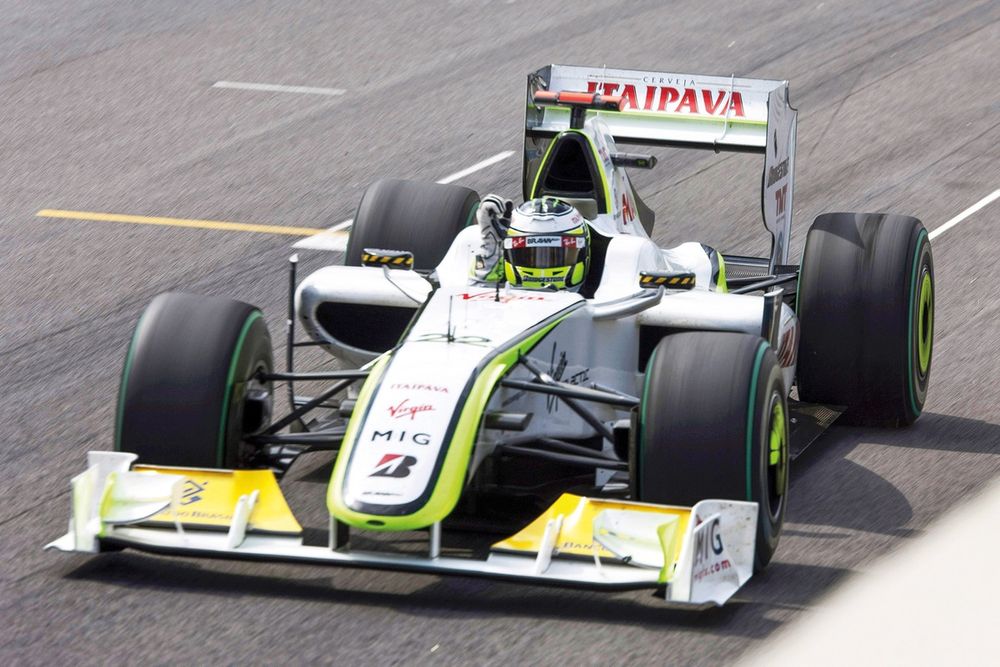
Brawn's secured a title double before transforming into Mercedes
Photo by: Darren Heath - Getty Images


Autosport magazine: Ferrari’s challenge and the pros and cons of F1 2026

When an F1 champion ruled the BTCC

The greatest F1 title-winning campaigns

The greatest campaigns that didn't win the F1 title

Top 10 great lost F1 wins

Autosport magazine: Your essential F1 2026 guide

Top 10 best F1 cars that didn’t win a title

Ferrari’s last front-engined winner

What happened to Evans and Solberg at WRC Rally Croatia

WRC Croatia: Pajari holds off Neuville to lead after Friday drama

The key figures Red Bull has lost over the past three years

Trackhouse team owner on why MotoGP must take risks to grow in the US
Subscribe and access Autosport.com with your ad-blocker.
From Formula 1 to MotoGP we report straight from the paddock because we love our sport, just like you. In order to keep delivering our expert journalism, our website uses advertising. Still, we want to give you the opportunity to enjoy an ad-free and tracker-free website and to continue using your adblocker.


Top Comments